Reduced onboarding time from 1 week to 4 hours
At SafetyCulture, I led the product design to reduce enterprise churn during onboarding.
Admin time fell from a week to four hours. First-30-day drop-off fell by 12%.
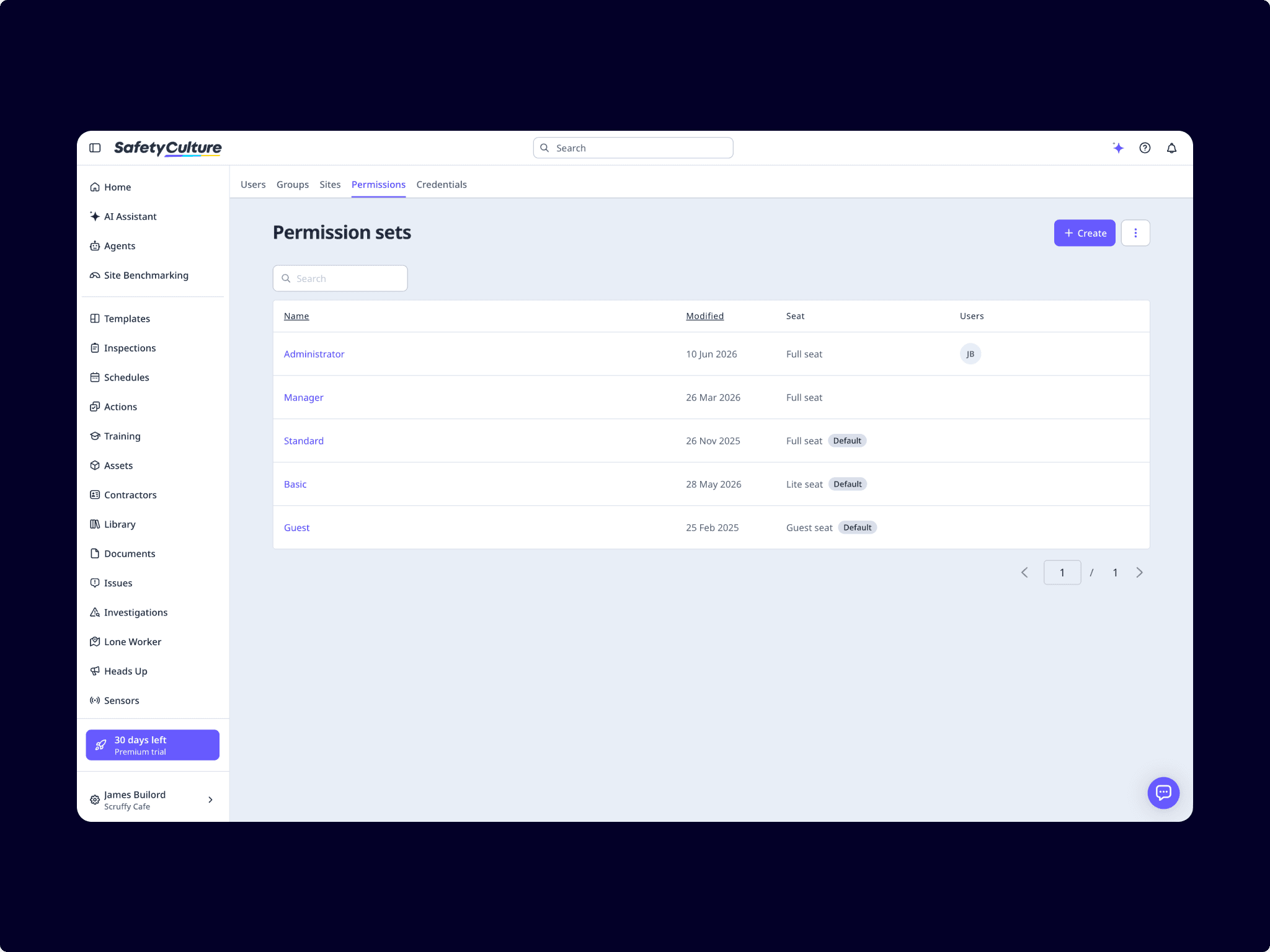
The core of our solution was the transition to a self-serve RBAC system. We replaced the overwhelming, granular checklist of individual permissions with a streamlined set of predefined roles.
Research
SafetyCulture provides industry-leading safety and operations software used by teams worldwide. As the platform expanded its enterprise footprint, the complexity of managing large-scale deployments became a critical bottleneck. Enterprise customers were provisioning access for hundreds of new users every fortnight, dealing with rotating shift patterns, intricate site hierarchies, and varied permission tiers that did not fit into a basic email invite flow.
Challenge
Admins of enterprise were losing a working week to user management tasks that should have taken minutes. New users dropped off in their first month due to high friction in onboarding.
The project required us to rethink the core identity architecture of the iAuditor platform, shifting from an outdated, email-based identity system to a robust, self-serve access model that could handle the scale of global enterprise operations.
UX Research: The cost of a rigid system

The business impact of the legacy access system was clear. SafetyCulture had lost four large enterprise customers, and many more medium-to-large businesses churned due to scalability issues. The platform didn't plug into customers' existing ecosystems, preventing them from self-serving during their onboarding and establishment phases.
Internally, Customer Success engineers and managers were spending 4 to 6 weeks manually onboarding customers and building custom user management solutions that did not scale. On the client side, enterprise admins were losing a full working week to user management tasks that should have taken minutes.
To really understand the problem, I initiated a discovery phase involving customer interviews with major enterprise clients, including Transport for London, IKEA, and Australia Post. We needed to map out exactly how managers were currently attempting to handle identity management and where the system was failing them.
Customer interviews learnings
"We rely on our floor staff to be AAA compliant but that's not possible if they can't communicate with managers easily. I hope this operations platform can help us be more compliant."
- Regional Manager, IKEA
UX Research: Understanding customer's ecosystem
Alongside generative interviews, we conducted heuristic evaluations of industry-standard enterprise provisioning tools such as Workday, Okta, BambooHR, and Atlassian.
A key learning from this evaluation was that a flat Role-Based Access Control (RBAC) system is a solid foundation for scaling access, and that most operations platforms rely on centralized user provisioning to manage over 500 users.

Prototyping
UX Strategy: Navigating Technical & System Constraints
Defining the solution was only half the battle; we faced a technical and systemic constraint that meant we couldn't rebuild the entire identity system. Changing from an email-based identity system to an RBAC system was a massive technology shift. Engineering estimated it would take 2 to 3 months to fully build, and tech leads were unwilling to invest in such a large infrastructure project without months of planning.
To unblock this, we designed a Proof of Concept with the tech team, demonstrating how existing granular permissions could be logically grouped to act like Roles. This proved the feasibility of the transition without requiring a complete rewrite from day one.

Proof of Concept: We visually grouped existing permissions into intuitive roles based on UX Research
The Solution: Role-Based Access Control
To provide clarity around billing—a major pain point for enterprise procurement—we visually differentiated between 'Full seat' and 'Free seat' roles using clear iconography and labeling directly within the selection modal. This ensured admins knew exactly what access level they were paying for when assigning a role.

Granular options were still available for customers wanting to make custom roles
Edge-case Design: Customer Roles
Recognizing that enterprise structures are rarely one-size-fits-all, we also introduced a custom role creation flow. The 'Add permission' interface utilized a two-column layout, separating role metadata (Title, Description) on the left from granular feature permissions on the right, giving advanced admins the flexibility they needed without cluttering the default experience.
This option also helped us learn what kind of roles customers wanted at scale.
Full self-serve experience: Bulk Management at Scale

To directly address the working week lost to manual user management, we designed a comprehensive bulk upload and management suite. The 'Bulk upload users' flow allowed admins to import CSVs and review the data in a structured, five-step process.
A critical innovation in this flow was the inline error handling. Instead of rejecting an entire CSV file for a single mistake, the system highlighted specific row errors—such as 'Duplicate site name found'—allowing admins to make immediate corrections directly within the UI.
Outcome & lesson
The scalable user and access management system changed how enterprise customers onboarded on to SafetyCulture. By empowering managers with self-serve RBAC and bulk management tools, we eliminated the need for our Customer Success team to build custom, unscalable onboarding solutions.
12%
Reduction in Onboarding Churn
4 hours
Instead of Weeks to Onboard
4 clients
Successfully Onboarded
Onboarding time dropped from 1 week to just 4 hours.
Book a consultation